
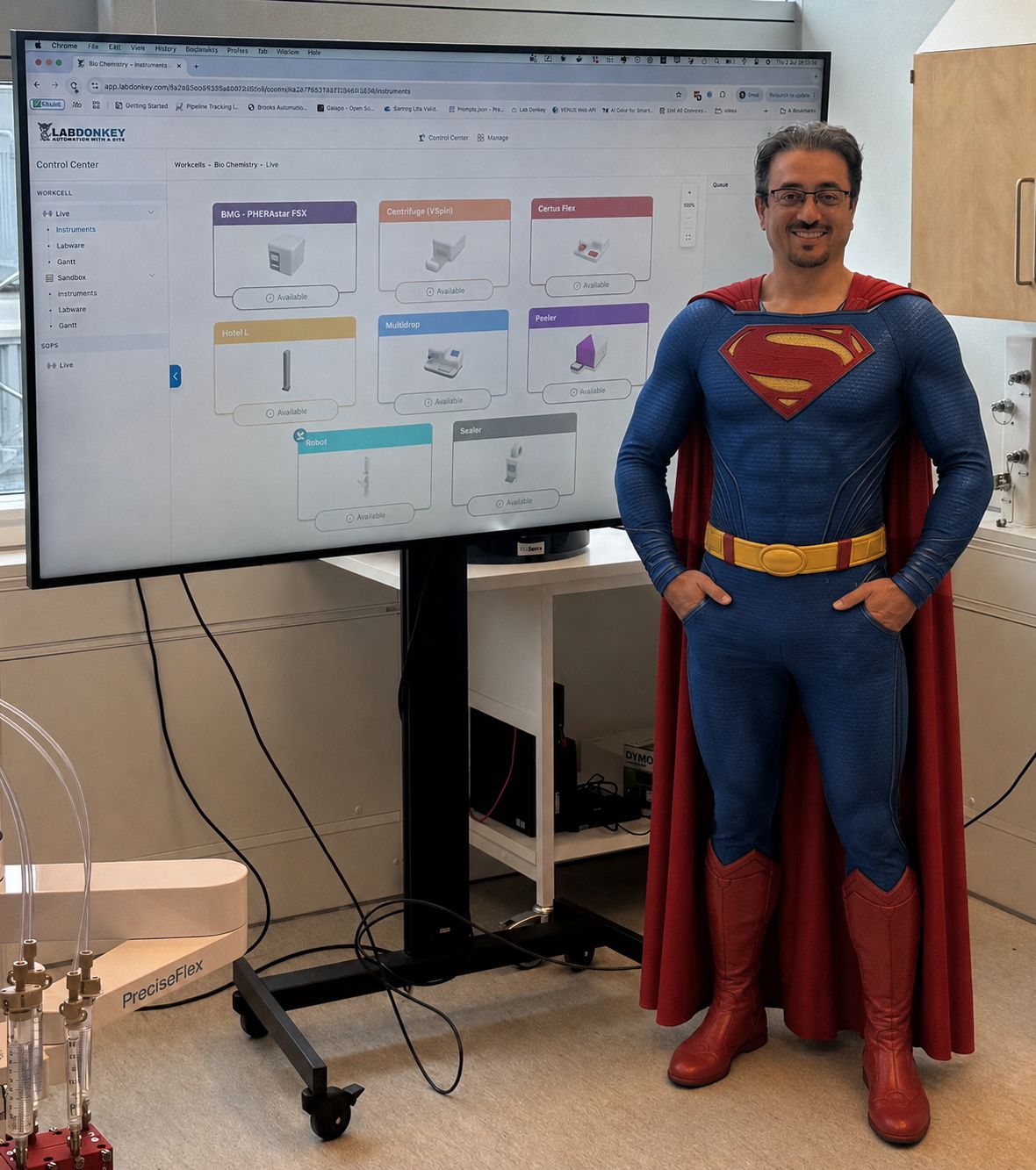
Two weeks ago, I was heading back to our LAB DONKEY lab at the AstraZeneca BioVentureHub when I decided to stop by another lab running Lab Donkey.
I walked in and immediately saw red lights blinking across the bench.
So, naturally, in my best Superman voice, I said, "What's going on? How can I help?"
Superhero complex. I know.
Behind the confidence, I was panicking.
They were running their newly minted 384-sample RNA extraction workflow, and the cost of a failed run is huge. Not just financially, but in samples, scientist time and all the work that went into getting to that point.
We haven't had a lost run with LAB DONKEY in over 1.5 years, but that fear never completely goes away. Every new workflow, every update, every change introduces some level of risk, and somewhere in the back of my mind I'm always thinking: is today the day?
Then the scientist leading automation in the lab turned to me, smiled, and said:
"Don't worry, Saf. We purposely broke LAB DONKEY."
Heartbeat back to normal.
Obviously, I needed him to explain.
While the run was going, they noticed that one of the instruments wasn't doing what it was supposed to do. So instead of letting the problem propagate through the workflow, they deliberately forced LAB DONKEY into an error state.
They then worked directly on the instrument, adjusted the protocol so it would dispense correctly, made sure everything was behaving as expected, and when they were ready, they simply told LAB DONKEY to continue.
And it did.
As I walked back to our lab, slightly disappointed that Superman hadn't actually been required, I realised what I had just watched was much bigger than a successful recovery.
I had watched two scientists confidently force an automation system into an error so they could fix a problem that had absolutely nothing to do with the automation itself.
They weren't afraid of touching it. They weren't afraid of ruining the run. They didn't feel like the system was holding them hostage.
They understood what was happening, they intervened, they fixed the science, and then they carried on.
That, to me, is what good lab automation should feel like. Not something scientists are scared to interrupt.
Something they trust enough to take control of when reality inevitably gets messy.
I probably wouldn't recommend deliberately breaking your automation on a normal day in the lab. But watching scientists feel confident enough to do it? That was pretty special.
Or, as my kids would say: That was sick.